
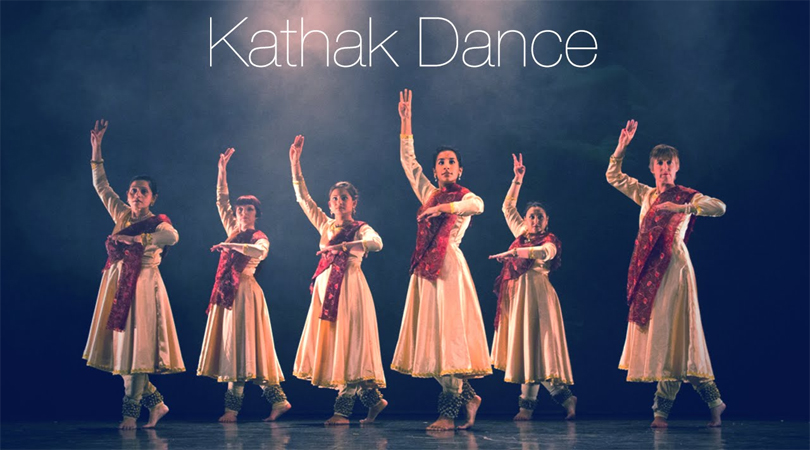
Kathak is one of the main genres of ancient Indian classical dance and is traditionally regarded to have originated from the travelling bards of North India referred as Kathakars or storytellers. These Kathakars wandered around and communicated legendary stories via music, dance and songs quite like the early Greek theatre. The genre developed during the Bhakti movement, the trend of theistic devotion which evolved in medieval Hinduism. The Kathakars communicate stories through rhythmic foot movements, hand gestures, facial expressions and eye work. This performing art that incorporates legends from ancient mythology and great Indian epics, especially from the life of Lord Krishna became quite popular in the courts of North Indian kingdoms. Three specific forms of this genre that is three gharanas (schools), which mostly differ in emphasis given to footwork versus acting, are more famous namely, the Jaipur gharana, the Benaras gharana and the Lucknow gharana.
Kathak is found in three distinct forms, called “gharanas”, named after the cities where the Kathak dance tradition evolved – Jaipur, Banaras and Lucknow.[8] While the Jaipur gharana focuses more on the foot movements, the Banaras and Lucknow gharanas focus more on facial expressions and graceful hand movements. Stylistically, the Kathak dance form emphasizes rhythmic foot movements, adorned with small bells (Ghungroo) and the movement harmonized to the music.[4][9] The legs and torso are generally straight, and the story is told through a developed vocabulary based on the gestures of arms and upper body movement, facial expressions, neck movements, eyes and eyebrow movement , stage movements, bends and turns. The main focus of the dance becomes the eyes and the foot movements. The eyes work as a medium of communication of the story the dancer is trying to communicate. With the eyebrows the dancer gives various facial expressions.[4][10] The difference between the sub-traditions is the relative emphasis between acting versus footwork, with Lucknow style emphasizing acting and Jaipur style famed for its spectacular footwork.[4]